If you have ever ordered Indian food in Britain, you have probably ordered Punjabi.
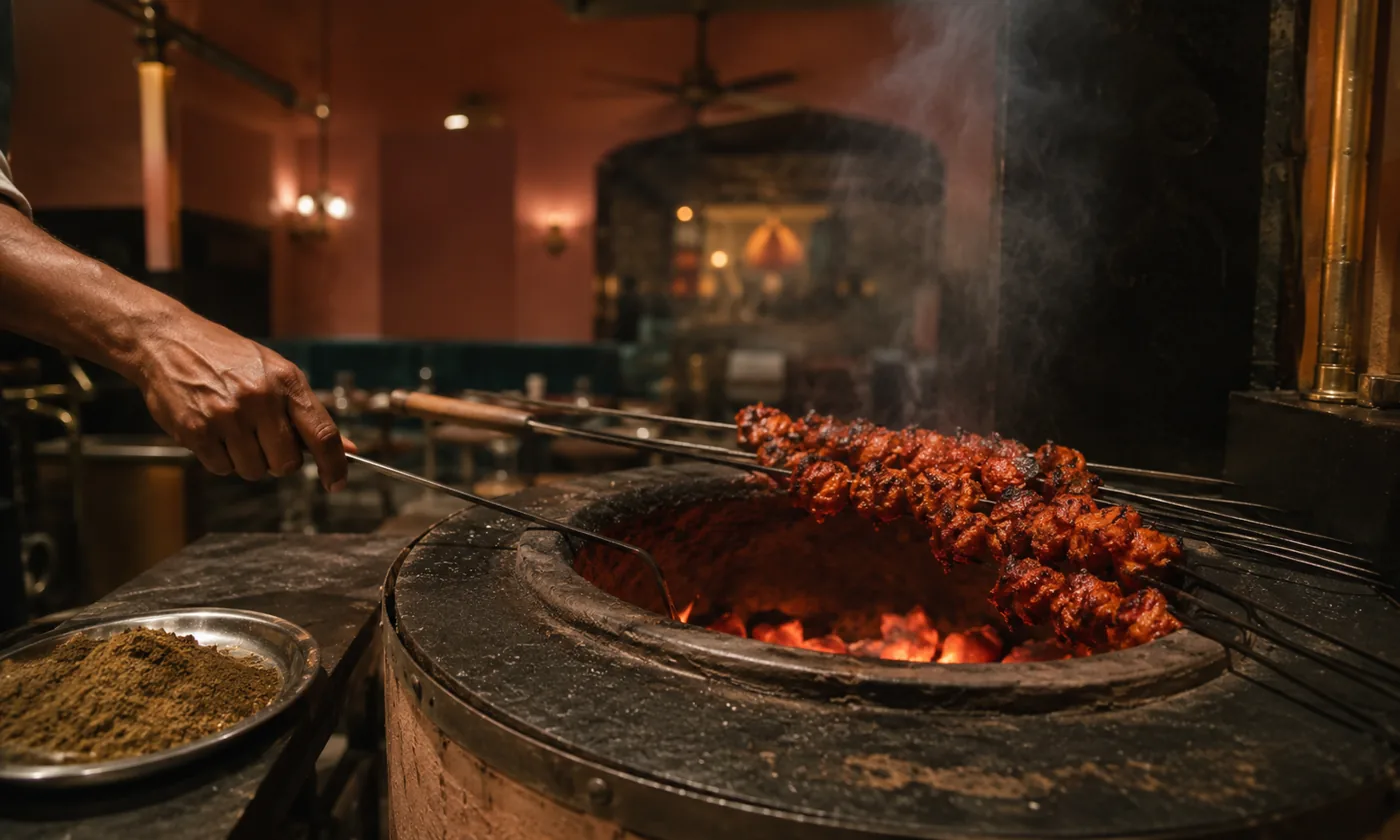
Punjab is wheat country, dairy country, tandoor country. The clay oven sunk into the ground belongs to the Punjabi kitchen the way a wood-fired oven belongs to Naples. Most of what Britain thinks of as 'Indian' food — tandoori chicken, naan, seekh kebab, paratha — is in fact Punjabi, exported west by waves of migrants who opened the first Indian restaurants in London, Birmingham and Cardiff in the fifties and sixties.
It is not the whole story. But it is a beautiful chapter of it. Chicken Tikka Masala is part of that same lineage — a tandoori-charred chicken finished in a tomato-cream gravy, invented in a British kitchen by a Punjabi chef. We make it the way it should be made: chicken charred properly first, sauce sweet from tomato and patient from time.
Kashmir is the only Indian region whose food still tastes of cold weather.
The valley sits at six thousand feet. Winters are long, summers are short, the cooking adapted. Kashmiri food is built on dried things — dried ginger, fennel, black cardamom, dried Kashmiri chilli for colour without heat — and on slow lamb. The flavours are deep, not loud. The technique is patience.
Two streams run side by side. Wazwan is the formal Muslim Kashmiri tradition — multi-course feasts at weddings, mostly mutton, cooked by a hereditary line of chefs called Wazas. Pandit cooking is the Hindu Kashmiri kitchen — no onion, no garlic, but plenty of asafoetida and dried mango. Both share the colour palette: deep red from a chilli that doesn't burn, the gold of saffron, the pale brown of slow-rendered ghee.
We serve Rogan Josh the Kashmiri way — fennel, dried ginger, black cardamom, the chilli for colour. No tomato, no onion paste, no curry-house shortcut. The lamb is cooked till it gives up. The sauce is the colour of mahogany. It belongs in a copper bowl.
The valley shows up in the tandoor too. Our Kashmiri Lamb Chops marinate for a full day in yoghurt, Kashmiri chilli, black cumin and a little fennel before they hit the fire. And the chai list ends, properly, with Kashmiri Kahwa — green tea, saffron, a slivered almond, a single dried rose petal. The tea you serve a guest in a Srinagar living room.

A cuisine forged by drought, royalty and the hunt.
In a desert state where vegetables travelled poorly, Rajasthani cooking learned to live without them — using yogurt, gram flour, dried lentils and milk solids in their place, plus generous fistfuls of red Mathania chillies. The food is correspondingly bright, hot, and built to last.
Laal maas — 'red meat' — is the dish of Rajasthani royal hunting parties. Lamb braised in a furious quantity of dried red chilli, garlic and yoghurt, finished with a smoke of clove and ghee. The colour is alarming. The heat is real. It is one of the great curries of India.

Mumbai eats on its feet, on the train, at the chai stall outside the office, at the Irani café at midnight.
The city's food is what twenty million people eat between commutes. It comes from a stall, a bun, a paper cone, a shared plate at a marble table. It is fast in the cooking and slow in the eating — a vada pav stretches a tea break, a plate of pao bhaji holds a whole conversation. The Mumbai kitchen reads like a list of things you can eat with one hand.
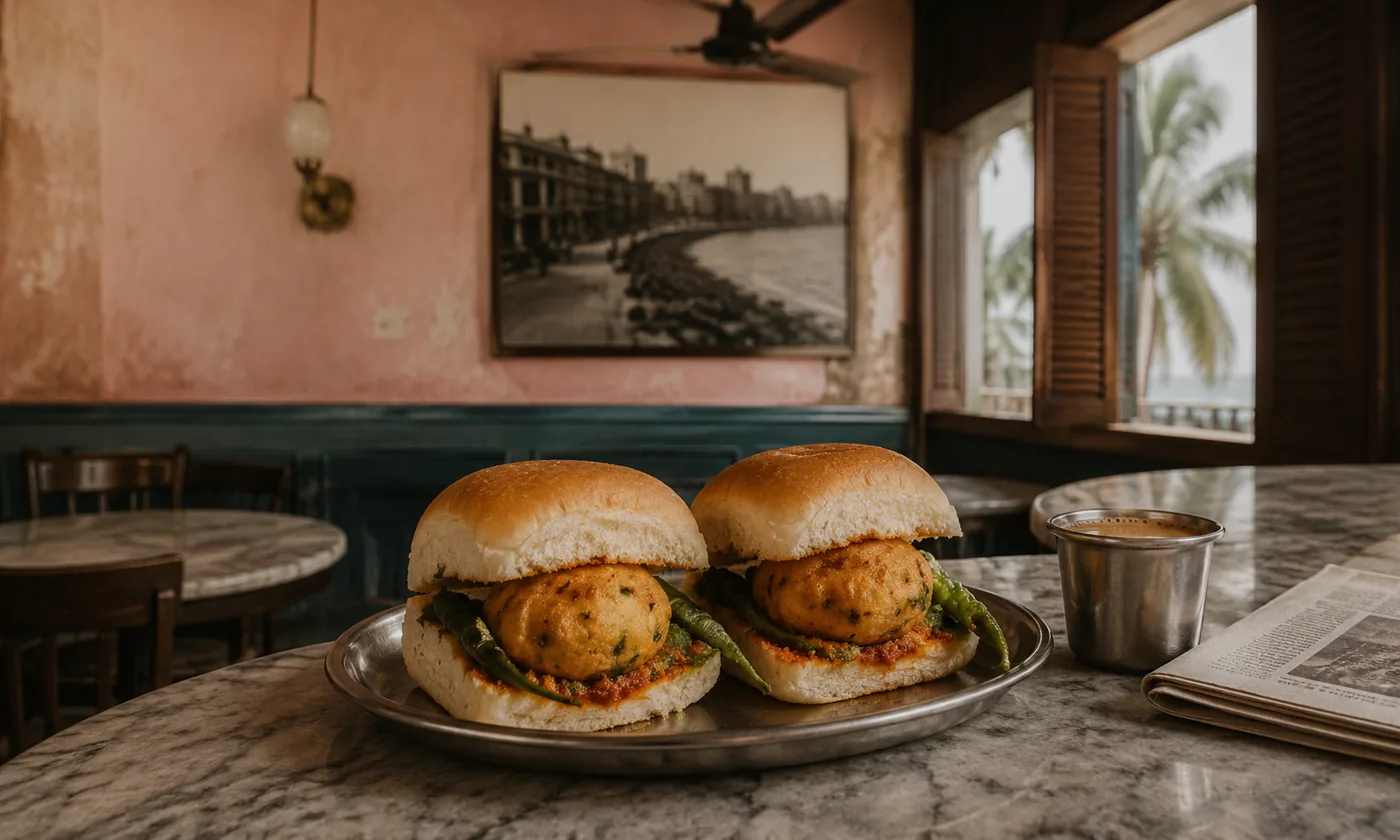
There is a particular Bombay institution worth knowing about: the Irani café. Persian-Zoroastrian families opened them in the early 1900s — marble tables, ceiling fans, bentwood chairs, a glass case of bun-maska, a cold beer with the keema pav at any hour. Britannia, Kyani, Yazdani. They are the closest thing to our own room — and they are where the brunch idea on this menu comes from.
We do vada pav properly. A fat green chilli stuck in the side, garlic chutney, soft pav, the potato fritter still hot. Keema pav is the late-night Bombay favourite — lamb mince in a pan that's been on the heat for an hour, plenty of butter on the bun. Pao bhaji comes from the 1850s mill streets, where workers wanted a quick hot meal that wasn't a roti. The Iranis would call our Kejriwal Benedict sacrilege — but it's our take on the chilli-cheese toast they served, with two poached eggs on top, for the long Bombay morning.
The Bombay Bloody Mary is the brunch's gift back to the city — vodka, tomato, chaat masala, green chilli, a salted rim with cumin. The drink Mumbai would have invented if it had thought of it first.
Calcutta is the most romantic city to eat in.
The Bengali kitchen is gentle, mustard-driven, fish-leaning. Bengalis eat in courses — bitter first, sweet last — and they take their time. The streets eat differently: paratha at the corner, jhal muri in a paper cone, kathi rolls from a wallah whose family has been at the same junction since before independence.
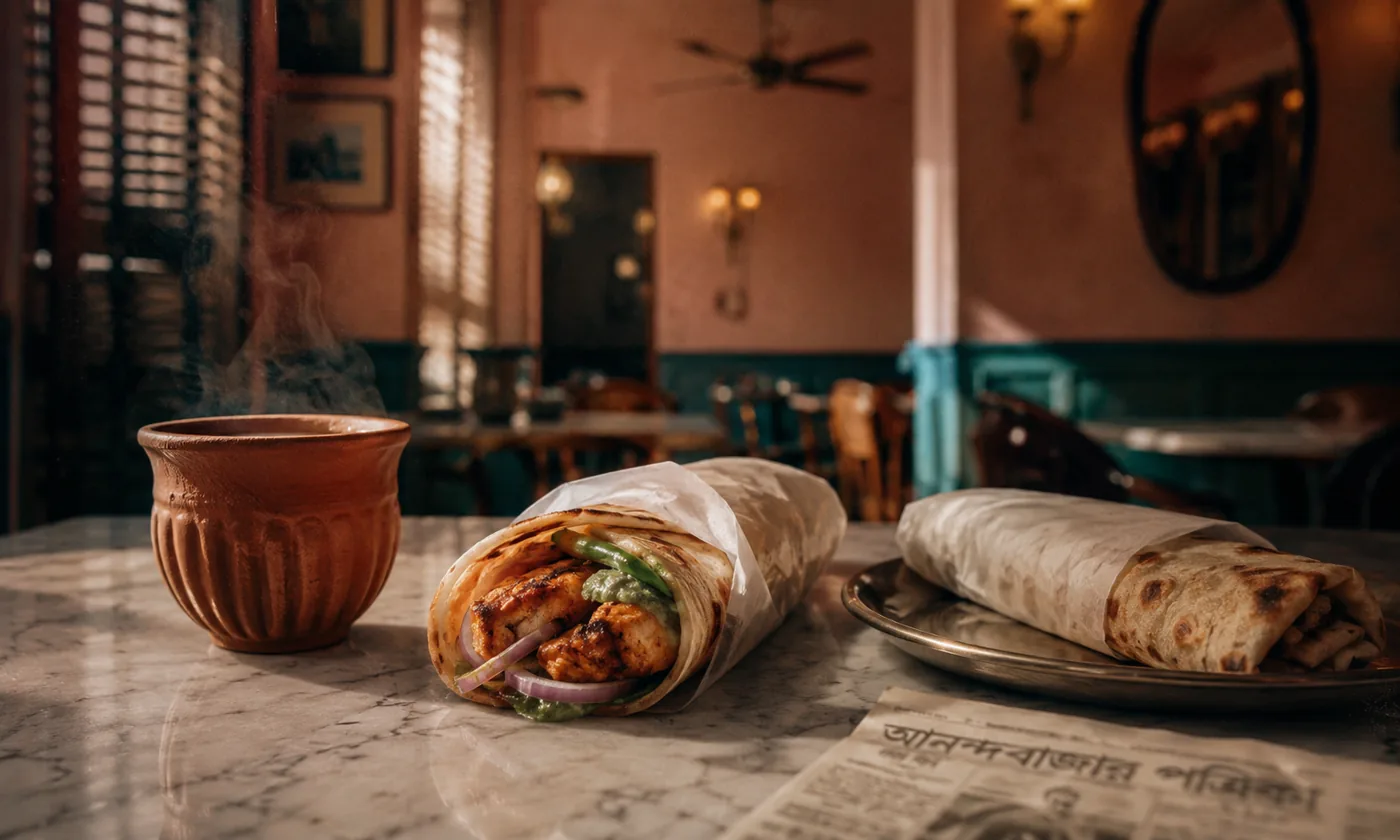
The kathi roll was invented in 1932 at Nizam's, a small restaurant on Hogg Street that's still open. The story is that British clerks didn't want to eat kebabs with their hands — they wanted them wrapped. So Nizam's wrapped them in a paratha, with onion, lime and chilli. The world's first wrap, predating burritos and shawarma. Ours is naan-wrapped, but the spirit is the same — meat from the fire, pickle, chutney, eat as you walk.
Kolkata also has a Chinatown. Tangra, on the city's eastern edge, was built by Hakka migrants in the 1700s and 1800s. The community cooked Chinese food using Indian ingredients and Indian palate expectations — sticky, sharp, hot. It became its own cuisine: Indo-Chinese. We treat it as the Tangra wok deserves — and the Indo-Chinese tradition has its own page below.
Bengal also sends us its mustard. The Bengali Salmon in our tandoor is a nod to a fish-eating riverine culture — yoghurt, mustard oil, charred edges. A Bengali aunt would tell you it should be hilsa, not salmon, and she would be right. We use salmon because the Severn doesn't run hilsa.
The home cooking of Tamil Nadu's most well-travelled people.
The Chettiars were merchants who traded across South-East Asia for centuries — Burma, Malaya, Ceylon, Vietnam. They came home rich, with star anise, kalpasi (stone flower), Marathi moggu (dried caper buds) and a finely calibrated love of black pepper. Chettinad cuisine is what those merchants ate at home: deeply spiced, dry-fried more than wet-cooked, dark and aromatic rather than chilli-hot.
It is one of India's great regional cuisines and almost completely absent from British high streets, where 'South Indian' usually means dosas and not much else. Our Duck Chettinad — a relatively recent invention, since duck wasn't traditional, but a brilliant fit for the spice profile — is one of our quiet signatures. Alongside it, two Tamil street classics: Devilled Beef, the railway-station dish of soy, tomato and curry leaf; and Chicken 65, a yoghurt-brined fry-up named after a 1965 Madras military canteen recipe.

Half this kitchen's hands grew up cooking Keralan food.
Kerala is a thousand-kilometre strip of coast at India's southwest tip. Coconut grows on every road. Spice arrives by boat — pepper, cardamom, ginger — and has done since the Romans, the Arabs, the Portuguese, the Dutch and the British. Kerala has been multi-religious and multilingual for two thousand years. Its food is correspondingly broad: Hindu temple food, Syrian Christian feasts, Mappila Muslim kitchens, Jewish Cochin cooking. The common thread is coconut — milk, oil, scraped flesh, water — and curry leaf, fried in coconut oil till they crackle.
The Keralan stream runs through this menu more than any other. Iddiyappam — steamed string hoppers served with a coconut stew — is what breakfast is, in a Kochi house on a Sunday morning. The Pan-Seared Sea Bass on curry-leaf mash with raw-mango sauce is a dish this kitchen has been cooking, in one form or another, for twenty years. Kerala Fish Moilee is the Sunday lunch dish of the Syrian Christian community — coconut, kokum, curry leaf, white fish, very little chilli. Keralan Chilli Squid is what fishermen's wives cook with what comes back on the boat that day.
Sulaimani Chai belongs here too. A Mappila tradition from the Malabar coast — black tea, lemon, cardamom and clove, no milk. Served after a heavy meal, on the verandah, late afternoon, as you start thinking about dinner.
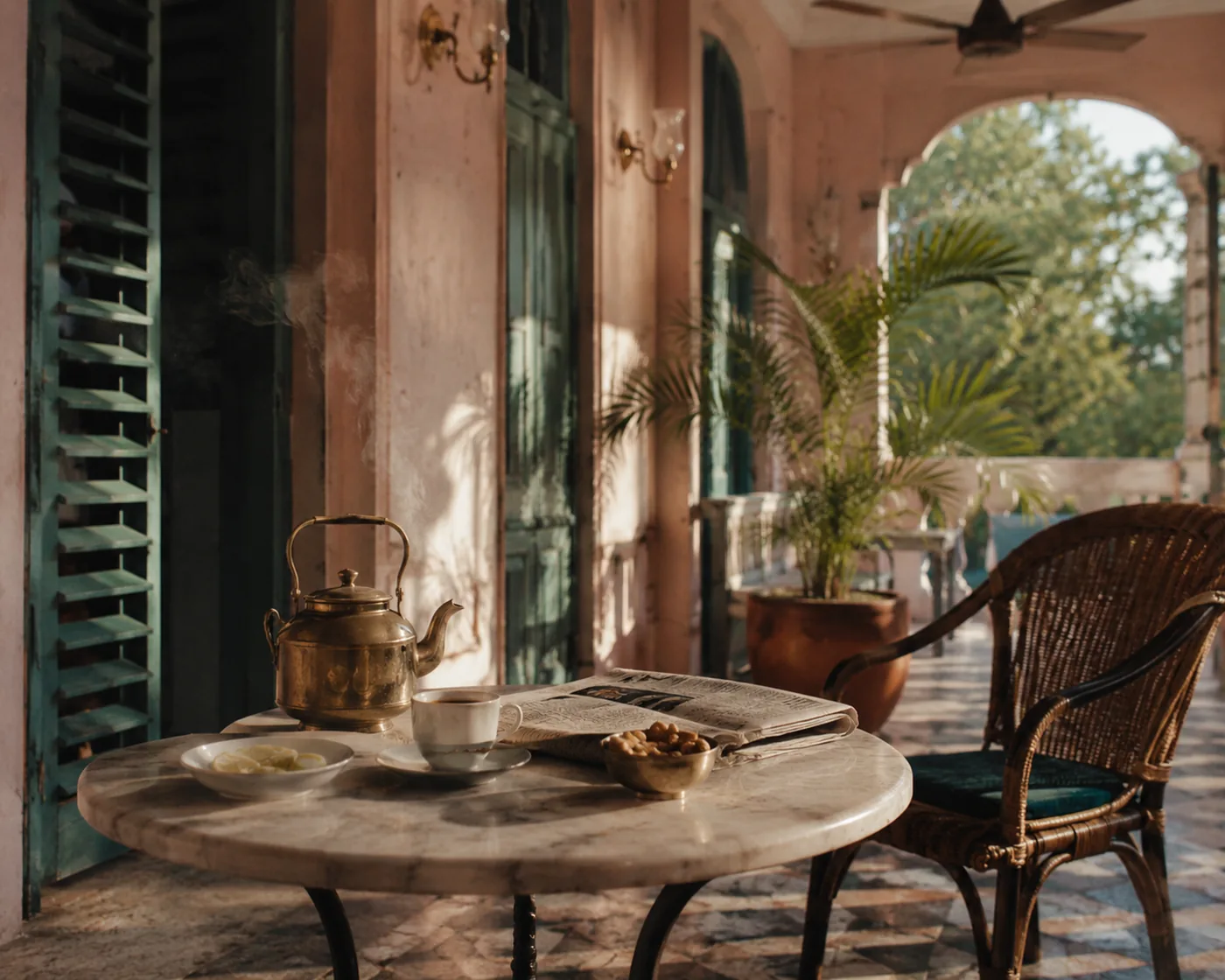
The Kerala line on this menu is the reason for the room more than any other region. The bungalow we describe — verandah, ceiling fan, bar opens at four, chai at sundown — is a Kerala house. Mint & Mustard, before this room was Chai St, was a Keralan kitchen. The ancestry runs straight through.

The biryani belongs to Hyderabad the way pizza belongs to Naples.
Hyderabad sits in the centre of the Deccan plateau — too hot, too dry, too flat to be obviously hospitable. But for two centuries it was the capital of the Nizams, the wealthiest royal court in India. Persian cooks, Mughal techniques, a Telugu pantry. The Nizam's kitchen ran like a small army; recipes were guarded; banquets ran for days. What survived is layered, slow, and worth queueing for.
The city's gift to India's table is the dum biryani. Rice and meat are layered into a clay handi, the lid is sealed with a strip of dough, and the whole thing is left to cook in its own steam over coals for forty minutes. Nothing is added once the seal goes on. The rice, the saffron, the spice and the meat all become each other. When the seal cracks open at the table, the steam is the dish.
We cook ours the same way. Veg, chicken, lamb or prawn — your choice goes into the handi, the lid is sealed, you wait. Mirch ka salan comes alongside — peanuts, sesame, tamarind, green chilli, a sour-sweet sauce that exists only to be eaten with biryani. Burani raita to cool everything down. The Maharaja Thali at the long table includes a whole biryani, because an Indian feast for two without one isn't really a feast.

Indo-Chinese is the oldest fusion cuisine in India, and most Indians don't know they're eating it.
Chinese migrants — Hakka people from southern China, mostly — settled in Calcutta from the 1700s onward. They worked the docks, the leather trade, the sugar mills. By the 1900s there was a full Chinatown, Tangra, in the city's east. The community cooked Chinese food because that's what they ate at home. But they used Indian ingredients, more chilli than they'd grown up with, more soy because soy was new and exciting, more garlic because garlic was cheap and good in Bengal. Within two generations the result was unrecognisable as either Chinese or Indian. It was Indo-Chinese.
By the 1970s the cuisine had escaped Tangra and gone national. Every Indian city has a Chinese restaurant now, and the menu is much the same: Hakka noodles, chilli chicken, gobi manchurian, schezwan prawns, chilli paneer. None of these dishes exist in China. All of them are essential to Indian eating.
We cook them the way they should be cooked — fast, on a screaming wok, with green chilli and soy. Hakka Noodles are wok-tossed with ginger, greens and your choice of veg, chicken or prawn. Chilli Chicken is dry-tossed in soy and spring onion. Gobi Manchurian — battered cauliflower in a sticky garlic-chilli sauce — is the vegetarian standard. Schezwan Prawns carry the heat the cuisine is named for. Devilled Beef, the South Indian railway-station cousin, lands here too — wok-tossed in soy, tomato and curry leaf. Sweet, hot, sticky.
These are the dishes for the table at half past nine when one more plate is exactly what's needed.